In a hurry? Start here
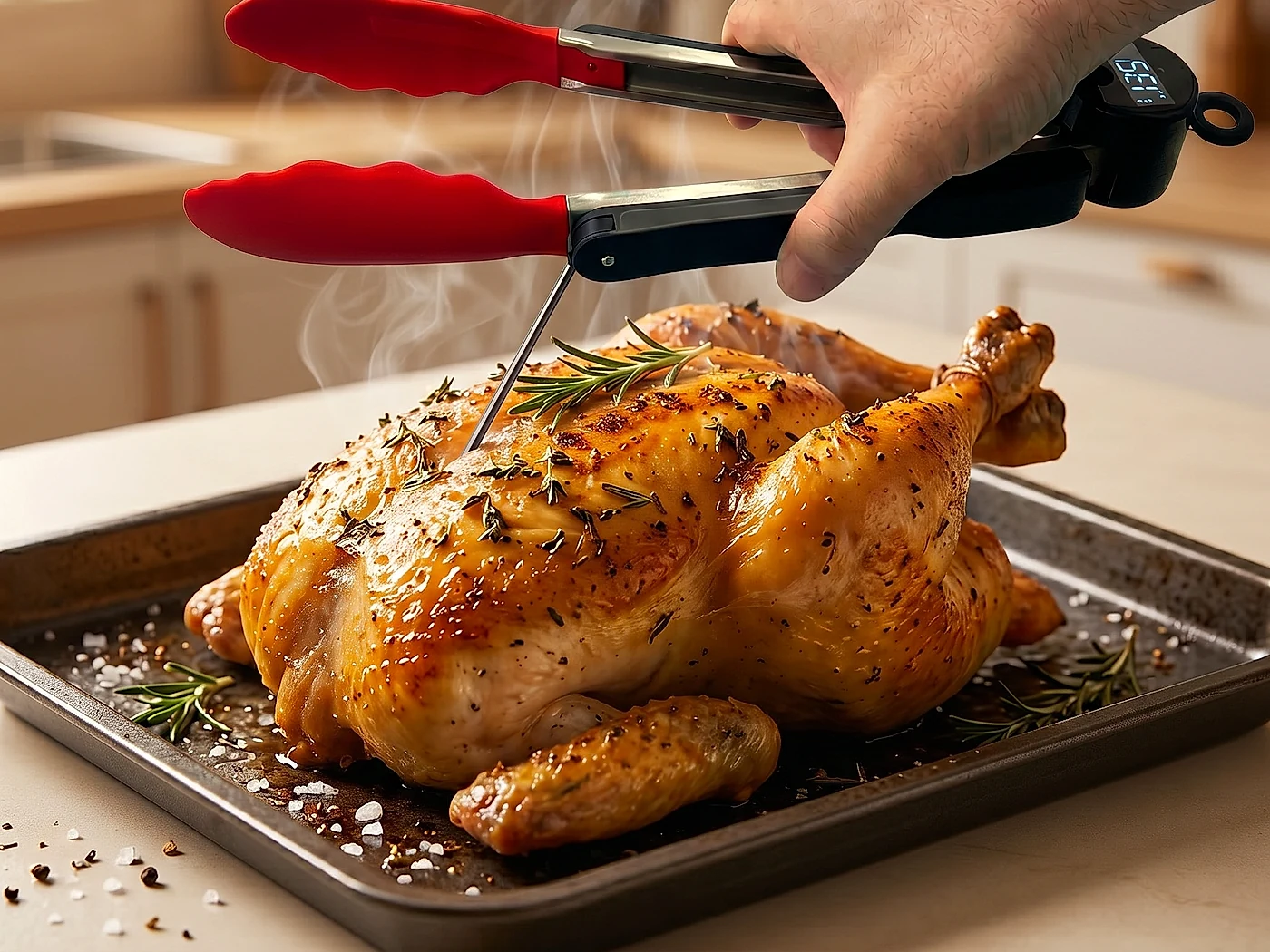
If you are learning how to use thermometer tongs, handle the food with the tong ends first, then unfold the probe when you are ready for a brief temperature check. Place the probe according to current guidance for the food you are cooking, wait for the reading, and remove the probe. KINGEAR ThermoTongs are made for spot checks. They are not a leave-in thermometer and should not stay in the food while it cooks.
What thermometer tongs actually combine
Thermometer tongs put two familiar jobs in one 12-inch tool. The tong ends grip, lift, and turn food. A built-in fold-out probe handles brief temperature checks. You can see the current product details on the ThermoTongs product page.
The useful part is the sequence. Use the tongs as tongs, keep control of the food, and unfold the probe only when you need a reading. Remove it after the reading appears. A leave-in monitor is better for following one point over time, while a separate instant-read thermometer may suit checks that do not involve handling the food.
Before the first temperature check
Before cooking, identify the food and the guidance that applies in your market. Safe temperatures and measurement instructions are food specific. The KINGEAR U.S. Grill Guide is a starting point for United States cooking guidance, but it does not turn one probe position into a rule for every food.
Next, plan how raw food and ready-to-eat food will stay separate. The CDC advises keeping raw meat, poultry, seafood, and eggs away from food that will not be cooked. Use separate plates or boards for raw ingredients and ready-to-eat food. This is ordinary food handling, but it matters when the same cooking area is busy.
Finally, make sure you know which part of the food needs to be checked. For whole cuts of meat other than poultry, current CDC guidance says to place the thermometer in the thickest part. For poultry, the CDC lists three check locations: the innermost part of the thigh, the innermost part of the wing, and the thickest part of the breast. Those are food-specific instructions. They should not be stretched into a universal rule for burgers, thin fillets, or every other food.
How to use meat thermometer tongs at the grill
1. Grip and turn with the tong ends
Start with the part of the tool that already feels familiar. Grip the food with the tong ends, lift only as much as needed, and turn it with a controlled movement. Keep the fold-out probe out of the food until you are ready to check temperature.
2. Pause before unfolding the probe
Choose a stable moment. If the grill is flaring or the food is slipping, settle that first. Place the probe deliberately rather than pushing it in during a rushed turn.
3. Unfold the probe for the spot check
Open the built-in probe when you are ready to measure. ThermoTongs use a fold-out probe, so the measurement step is separate from ordinary gripping and turning.
The probe is for a brief check. It should not remain in the food while the food continues to cook. If you need continuous monitoring, use a thermometer designed for that job.
4. Use a food-specific measurement location
Put the probe where the current official guidance tells you to check that food. For a whole cut of beef, veal, lamb, or pork, the CDC instruction cited above is the thickest part. Poultry requires checks at the three listed locations rather than one generic "center" check.
For foods not covered by those examples, consult the current guidance for the exact food and market. Do not guess a universal position from the shape of the food, and do not assume that advice written for a turkey automatically applies to a burger or thin chop. Probe placement deserves its own answer because the correct location changes with the food.
5. Wait for the reading
ThermoTongs return a reading in 1 to 2 seconds. That is a response-time statement. It describes how quickly the reading appears during the spot-check workflow.
It does not prove a particular accuracy specification, guarantee that the food is done, or make food cook faster. Response time and measurement accuracy are different claims. You still need to compare the displayed temperature with current guidance for the food you are cooking.
6. Remove the probe and continue cooking or serve
Once you have the reading, remove the probe from the food. If the temperature has not reached the applicable target, continue cooking and check again when another reading will help. If the food is ready, move it to a clean plate or serving surface that was not used for raw meat.
After the cooking session, handle the food-contact surfaces according to the current product instructions. Do not assume the whole tool can be immersed, rinsed under running water, or placed in a dishwasher unless the instructions for your exact version expressly allow it.
Make each spot check answer one cooking decision
A temperature check is most useful when you know what you will do with the result. Before unfolding the probe, identify the current guidance for the food and the location that guidance tells you to measure. Also note whether the guidance includes another step, such as additional cooking or a rest period. That way, the displayed number is part of a complete decision rather than an isolated reading.
Set up the next action before you measure. Keep a clean serving plate within reach, and keep any surface that held raw food out of the ready-to-eat area. If the food is slipping, the grill is flaring, or you cannot place the probe deliberately, regain control with the tong ends first. The handling moment and the measurement moment can happen in one sequence, but they should not become one rushed motion.
After the reading appears, remove the probe and compare the result with the current guidance you selected. If the food needs more cooking, continue cooking and take another brief check when it will inform the next decision. If the food is ready under that guidance, transfer it to the clean serving surface. Do not leave the probe in place while waiting for the temperature to change.
This repeatable order also makes the limits of the tool easier to remember: handle, pause, unfold, place, read, remove, then decide. Thermometer tongs support a hands-on spot-check workflow. They do not replace food-specific measurement instructions, a leave-in monitor, clean serving equipment, or the care directions for the exact product version you own.

What a 1 to 2 second response means
A quick response can make a spot check less disruptive. You grip or turn the food, place the probe, read the display, and remove the probe without turning the check into a long separate step.
The number does not carry extra promises. It is not an accuracy certificate, and it does not prove doneness without the correct placement and food-specific target. A fast answer to the wrong measurement question is still the wrong answer.

When another thermometer is the better tool
Choosing a thermometer is easier when you start with the measurement job rather than the product category.
| Cooking task | Tool that may fit best | Why |
|---|---|---|
| Grip, turn, and take a brief temperature check in one sequence | Thermometer tongs | The tong ends and fold-out probe support the same hands-on workflow. |
| Watch one point continuously while food cooks | Leave-in thermometer | It is designed to remain in place and track temperature over time. |
| Check many items without needing to grip or turn them | Separate instant-read thermometer | The measuring tool can move independently from the handling tool. |
| Turn or serve food with no temperature check | Ordinary tongs | No measuring function is needed for that task. |
Thermometer tongs are a sensible choice when the handling and measurement moments overlap. They are less useful when you need continuous monitoring or when the food should not be moved during the check. Being honest about that boundary helps you choose the right tool before cooking rather than fighting the wrong one halfway through.

Common mistakes that make a spot check less useful
One common mistake is relying on color or texture alone. Browning can tell you something about the surface, but it does not replace a temperature reading. The CDC recommends using a food thermometer to check whether food has reached a safe internal temperature.
Another mistake is using the same vague probe position for every food. "Put it in the center" sounds simple, but it hides important differences between a whole cut and poultry. Follow the instructions for the food in front of you. When the official source does not support a precise placement rule, do not invent one.
Leaving the probe in during cooking is also outside the intended ThermoTongs workflow. The built-in probe is for spot checks. Use a leave-in monitor when you need continuous measurement.
Raw-to-ready handling can cause a separate problem. Do not move cooked food back to the plate that held it raw. The CDC advises washing utensils, cutting boards, and countertops with hot, soapy water after preparing each food item. That is general kitchen guidance, not a claim that the complete ThermoTongs body is waterproof or dishwasher-safe.
Finally, do not confuse a fast response with proof of accuracy. The 1 to 2 second response describes timing. It does not establish an accuracy tolerance, and it should never be presented as one.
Cleaning and storage have a product-specific boundary
Food-contact surfaces need attention after cooking and when moving between raw and ready-to-eat food. The exact cleaning method for ThermoTongs must come from the instructions for the version you own. General kitchen hygiene advice does not prove that an electronic cooking tool can be immersed or placed in a dishwasher.
If the instructions for your unit are missing or unclear, stop short of experimenting with water exposure. Use the KINGEAR support page to request the current care guidance for your version.
Frequently asked questions
Can thermometer tongs stay in food while it cooks?
No. KINGEAR ThermoTongs are designed for brief spot checks, not continuous leave-in monitoring. Remove the probe after the reading appears. Use a leave-in thermometer when you need to watch temperature at one point throughout cooking.
Does a 1 to 2 second response prove the thermometer is accurate?
No. Response time and measurement accuracy are different claims. The verified statement is that ThermoTongs return a reading in 1 to 2 seconds. That does not establish a specific accuracy tolerance or guarantee doneness.
Do thermometer tongs replace every other type of thermometer?
No. Thermometer tongs suit a grip, turn, and spot-check workflow. A leave-in thermometer is better for continuous monitoring, while a separate instant-read thermometer may be more convenient when food handling and measurement are separate tasks.
Can color or texture alone show that meat is safe?
No. Surface color and texture do not replace a temperature check. Use a food thermometer and compare the reading with current official guidance for the food you are cooking.
The next check should answer a question
Use the tong ends to control the food and the fold-out probe when a spot check will change what you do next. Before measuring, know the target and the correct location for that food. After the reading appears, remove the probe and decide whether to keep cooking or move the food to a clean serving surface.
That is the practical role of thermometer tongs: one handling tool with a built-in way to take a brief reading, used within the limits of food-specific guidance.
Sources
- Centers for Disease Control and Prevention. Preventing Food Poisoning. Updated November 24, 2025. Accessed August 27, 2026.
- Centers for Disease Control and Prevention. Preventing Toxoplasmosis. Updated January 30, 2024. Accessed August 27, 2026.