The short answer
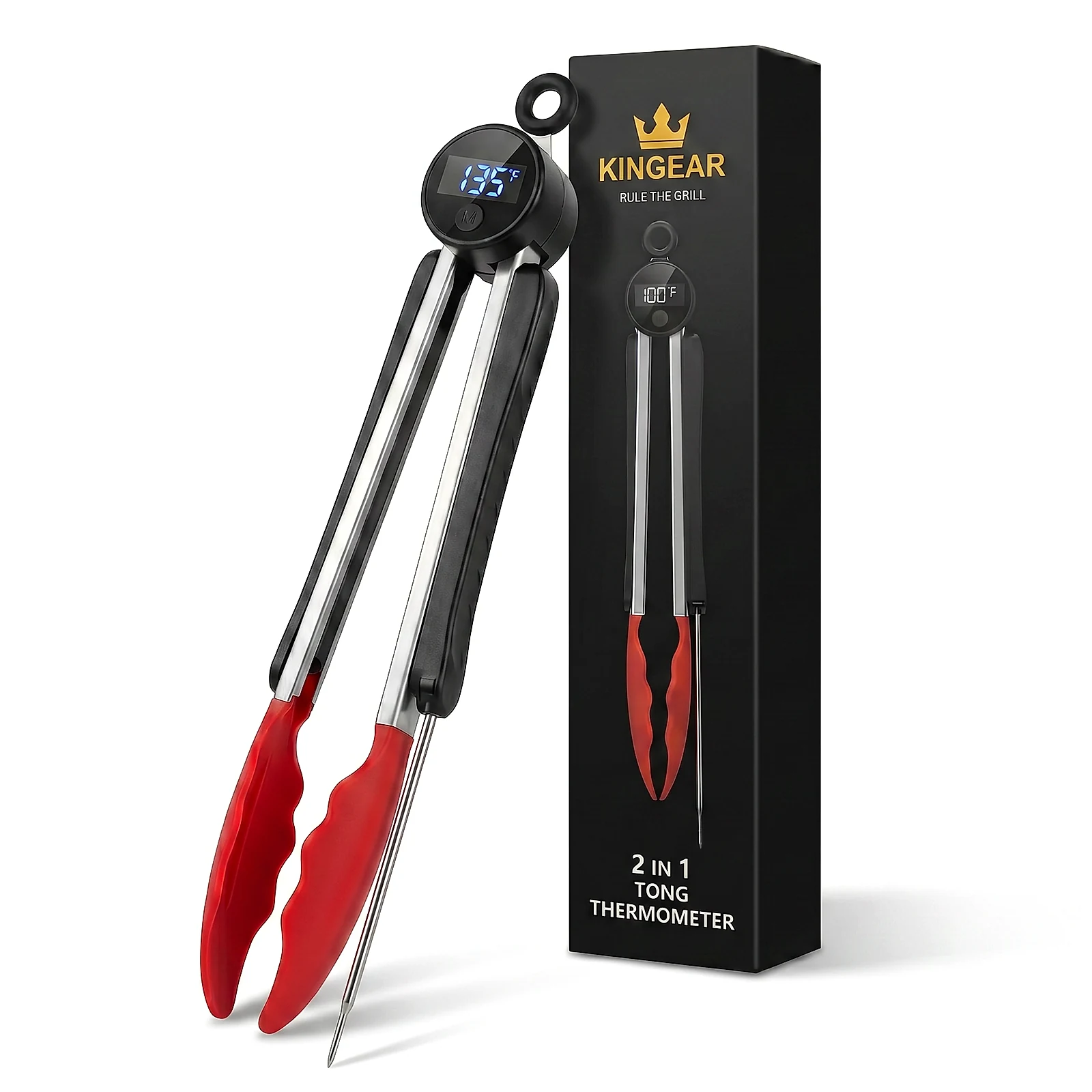
Choose thermometer tongs when gripping or turning food and taking a brief spot check belong in the same workflow. Choose a separate instant-read thermometer when measurement is its own task. Choose a leave-in thermometer when you need to follow one selected point over time. ThermoTongs combine food handling with a fold-out spot-check probe, but they are not a leave-in monitor and a 1 to 2 second response is not proof of accuracy.
Three tools can measure temperature, but they do different jobs
It is tempting to compare thermometer formats as if one should win every cookout. The more useful question is what happens around the reading. Are you pausing to measure and then putting the thermometer away? Are you watching one point through a long cook? Or are you already gripping and turning the food when you decide to check it?
A separate instant-read thermometer keeps handling and measurement separate. A leave-in tool follows a selected point while the food cooks, provided the manufacturer designed that probe to remain in place. Thermometer tongs combine two actions that often happen close together: handling the food and taking a brief temperature reading.
| Tool format | Best-matched job | What stays separate | Main limit |
|---|---|---|---|
| Separate instant-read thermometer | Brief readings at chosen moments | Food handling uses another utensil | Not automatically a continuous monitor |
| Leave-in thermometer | Following one selected point over time | Turning and serving still use another utensil | Only appropriate when the model is designed to remain in food |
| Thermometer tongs | Grip, turn, and spot-check in one hand-held workflow | Long-term monitoring remains a separate job | Not a leave-in thermometer |

When thermometer tongs make sense
Thermometer tongs fit a specific rhythm at the grill. You grip a piece of food, turn or reposition it, open the probe, take a spot check, and then continue cooking or serve based on the reading and the applicable guidance. That workflow can reduce the need to put one utensil down and reach for another measurement tool.
The current ThermoTongs product page supports four narrow facts that matter here. The tool combines BBQ tongs with a fold-out probe, has a 12-inch overall length, returns a reading in 1 to 2 seconds, and is intended for spot checks rather than leave-in monitoring.
Those facts describe fit, not a universal performance win. The 12-inch body can keep your hand farther from direct heat, but it does not make the tool burn-proof or guarantee safety. The response-time statement can reduce waiting during a chosen check, but it does not establish an accuracy tolerance or make food cook faster.
If this handling-and-checking sequence matches the way you cook, the detailed guide to using thermometer tongs shows how the grip, turn, unfold, place, read, and remove steps fit together.
Already own a thermometer? Find the missing job first
Start with what your current tools let you do, not with an empty shopping cart. Suppose you cook burgers with ordinary tongs and already have a separate instant-read thermometer that reaches the right spot comfortably. Thermometer tongs would offer a different handling-and-checking arrangement; they would not add an entirely new measurement category. Whether that change is useful depends on the tool switch you actually want to remove.
Now suppose your next project is a long roast and you want to follow its temperature without repeatedly stopping for manual checks. Buying another spot-check tool does not add continuous monitoring. A leave-in model designed for that environment addresses the missing job. Conversely, owning a leave-in probe does not mean its one selected location represents every part of the food or every item cooking beside it.
Write down the task your present setup cannot do well. If the answer is simply that a newer format looks convenient, compare its handling, access and cleaning requirements before replacing anything. Keeping a suitable tool is a valid outcome of this comparison.

When a separate instant-read thermometer may fit better
A separate instant-read thermometer makes sense when you want measurement to remain independent from the utensil in your hand. You might use the same thermometer across an oven, a pan, a roast, and a grill while choosing a different handling tool for each setting. You might also prefer to hold the probe at a particular angle without the added size of tongs.
The format does not remove the need to choose a supported probe location. A fast reading from the wrong place can answer the wrong question. Our meat thermometer placement guide keeps whole cuts and poultry separate because one generic center rule does not fit every food.
A separate tool is not automatically more accurate, either. Accuracy depends on product-matched evidence and verification, not simply on whether the probe is built into tongs or held by itself. Compare the actual evidence published for the model you are considering.
Thin food and crowded cooking spaces change the choice
A thermometer can suit the general job yet be awkward for the food in front of you. With a thin cut or a crowded pan, ask whether you can place the model's sensing area where it needs to be while holding the tool steadily. Iowa State University Extension notes that digital instant-read thermometers can be useful for thinner foods and emphasizes following the manufacturer's insertion instructions. That is not a claim that every digital probe fits every cut.
Overall tool length, probe length and sensing depth are different dimensions. ThermoTongs' stated 12-inch overall length does not establish the other two. If a listing does not document the fit you need, check the model's instructions or ask the seller before buying. A compact separate thermometer may suit a restricted working angle; integrated tongs may suit a handling-and-checking sequence. Choose the format that lets you make the required measurement without forcing an awkward reach.
When a leave-in thermometer is the right category
Choose a leave-in thermometer when the job is to follow one selected point during a substantial part of the cook. Depending on the model, that may include a display or an alarm, but those features must be verified for the exact product. The defining workflow is that the manufacturer designed the probe to remain in the food or cooking environment while temperature changes over time.
This is where ThermoTongs should be disqualified rather than oversold. They are a spot-check tool. You place the probe for a reading and remove it afterward. They do not replace a leave-in monitor for a long roast, low-and-slow cook, or any situation where an ongoing timeline is the main need.
Some cooks will reasonably own both formats. A leave-in thermometer can follow one point while a separate spot-check tool checks another item or location at a chosen moment. The choice is not about collecting gadgets. It is about covering genuinely different measurement jobs.
Meat thermometer vs grill thermometer: which temperature?
A grill-temperature reading and a reading inside the food answer different questions. The first helps describe the cooking environment; the second concerns the food at the probe's location. A hotter grill display is not evidence that the center of a roast has reached its target. This distinction matters more than whether two displays happen to show similar numbers.
Also check what a particular grill display represents. Traeger's support guidance, for example, explains that its model-specific controllers and third-party sensors can report differently because of sensor position and the controller's calculations. That explanation belongs to the equipment described; it is not a universal error allowance for all grills or thermometers. ThermoTongs' documented role remains brief food-temperature checks, not a substitute for a grill controller or an ambient monitoring system.
The reading still needs the right location and target
Tool choice is only the first decision. The reading must come from an appropriate location for the food, and it must be compared with current guidance for the food and market. The U.S. Grill Guide separates whole cuts, ground meat, poultry, fish, leftovers, and casseroles instead of presenting one number as the answer to every meal.
This matters in a comparison page because convenience can sound like a safety promise. It is not one. Integrated tongs can make a handling-and-checking sequence more direct, but they cannot choose the measurement point, identify the correct target, or guarantee doneness. A separate thermometer and a leave-in thermometer have the same limitation: the cook still has to apply them to the right question.

Include the cleanup between raw and cooked food
Think through a complete cook, including the moment you stop handling raw food and start serving. CDC guidance calls for cleaning utensils and keeping raw meat and its juices away from ready-to-eat food. Combining a probe and tongs does not remove those responsibilities. Cleaning only the probe does not establish that the gripping surfaces are ready for serving, and cleaning the gripping surfaces does not establish that the probe is clean.
Before choosing any electronic food tool, check how its food-contact parts should be cleaned and which parts must be protected from water. Follow the exact model's instructions rather than assuming that metal construction or silicone tips make the entire tool dishwasher-safe. For ThermoTongs, do not infer immersion or dishwasher permission from the two-in-one design. If the documented cleaning method will not suit your routine, that is a practical reason to consider a different arrangement.
A buyer checklist that avoids the wrong comparison
Before comparing prices, make sure the products are trying to solve the same job. A feature list becomes much more useful when each item connects to something you will actually do.
| Question | What the answer changes |
|---|---|
| Do I need a brief reading or an ongoing timeline? | Routes the choice toward a spot-check tool or a leave-in monitor. |
| Will I be gripping or turning food at the same moment? | Shows whether integrated thermometer tongs remove a real tool switch. |
| Is the response-time claim separate from the accuracy evidence? | Prevents a speed number from being mistaken for a precision claim. |
| Can I follow food-specific placement and target guidance? | Keeps convenience from replacing the measurement method. |
| Are cleaning, range, runtime, and alarm claims documented for this model? | Stops a competitor feature or category assumption from being transferred to another product. |
For ThermoTongs, current evidence supports the integrated spot-check workflow, 12-inch overall length, and 1 to 2 second response statement. It does not currently support a specific accuracy tolerance, waterproof or dishwasher-safe wording, a measurement range, a probe-length number, or a battery-runtime claim. Leaving those claims out is part of an honest comparison.
Frequently asked questions
What are meat thermometer tongs?
Meat thermometer tongs combine food-handling tongs with a probe for brief temperature spot checks. KINGEAR ThermoTongs are designed for gripping, turning, and checking in one hand-held workflow.
Are thermometer tongs a leave-in thermometer?
No. ThermoTongs are designed for spot checks. Remove the probe after the reading appears. Choose a leave-in thermometer when you need to follow one selected point over time.
Do thermometer tongs replace a separate meat thermometer?
Not in every workflow. Thermometer tongs can fit cooks who often handle food and take spot checks together. A separate instant-read thermometer may fit better when measurement is a separate task, and a leave-in thermometer fits continuous monitoring.
Does a 1 to 2 second response mean the thermometer is more accurate?
No. Response time and accuracy are different measurement claims. The 1 to 2 second statement describes how quickly the ThermoTongs reading responds. It does not establish a specific accuracy tolerance.
Who should consider thermometer tongs?
They are worth considering when gripping or turning food and taking brief temperature checks happen close together. They are not the right category when the main need is continuous monitoring, remote alerts, or a product-matched accuracy certificate.
Make the next cook decide the tool
If your next meal involves frequent gripping, turning, and brief checks, thermometer tongs may fit the workflow cleanly. If the reading is a separate task across several cooking settings, a separate instant-read thermometer may be simpler. If one point needs continuous attention, start with a leave-in model designed for that job. Choose the job first, then compare evidence for the exact product rather than assuming one thermometer format wins everywhere.
Sources
- ThermoWorks. What Kind of Thermometer Do I Need? Manufacturer category guidance on spot checks and monitoring, not an independent KINGEAR test. Accessed November 1, 2026.
- Traeger Support. Third-Party Thermometers. Equipment-specific context for grill displays and sensor location; not a general tolerance claim. Accessed November 1, 2026.
- National Institute of Standards and Technology. Mercury Thermometer Alternatives: Thermistor. Updated April 16, 2024. Accessed November 1, 2026.
- National Institute of Standards and Technology. Mercury Thermometer Alternatives: Verification Methods for Alternative Thermometers. Updated April 16, 2024. Accessed November 1, 2026.
- Centers for Disease Control and Prevention. Preventing Food Poisoning. Updated November 24, 2025. Accessed November 1, 2026.
- Iowa State University Extension and Outreach. Meat Thermometers: A Grilling Essential. Published June 28, 2022. Accessed November 1, 2026.