

Illustrative gift scene using an official product photograph. Numbers on the source photograph and packaging are not cooking-temperature recommendations.
The short answer: a useful Father's Day gift for a dad who grills fills a gap in the cooking he already does. For quick meals, that might be a food thermometer or a combined tong-and-probe tool. For long cooks, he may want a device specifically rated for ongoing monitoring. If his tools already suit him, favourite ingredients or a meal together can be a better choice. Canadian gift buyers should also check Celsius usability, care instructions and the conditions that apply to their delivery address before ordering.
The difficult part is buying for someone whose barbecue drawer you rarely open. A promising-looking gadget can repeat a job he already has covered. A small accessory can be an excellent gift, but only if it fits his equipment and habits.
You don't need to become the family's barbecue expert to make a thoughtful choice. You need a little information about an ordinary meal, a clear idea of what your gift should help with, and enough room for Dad's preferences. This guide is published by KINGEAR; ThermoTongs appears as one possible tool, with reasons it may or may not suit the recipient.
Ask about the last meal he cooked
Rather than asking what barbecue accessory he wants, ask what he cooked most recently and how it went. The answer gives you something concrete to work with. Perhaps he made burgers after work, smoked a large cut over several hours, or cooked vegetables while someone else handled the main dish.
Listen for a specific inconvenience. Did he keep going indoors for a tool? Was it awkward finding the centre of a thin burger? Did he already have a thermometer he likes? Was the real problem finding space for a clean serving platter? A gift can help with any of those jobs, but they call for different purchases.
If the surprise matters, ask someone who regularly cooks with him to check the drawer or cupboard. A photo of the actual tool and its model label is more useful than a description such as "one of those digital things." They should check only with permission, without opening private accounts or ordering history.
You can also make the question part of planning dinner: "Would you rather cook burgers together or try a longer barbecue recipe?" That tells you whether the gift could support a familiar routine or an experiment. Leave room for the answer to change your original idea. The object you spotted first doesn't have to be the one you buy.
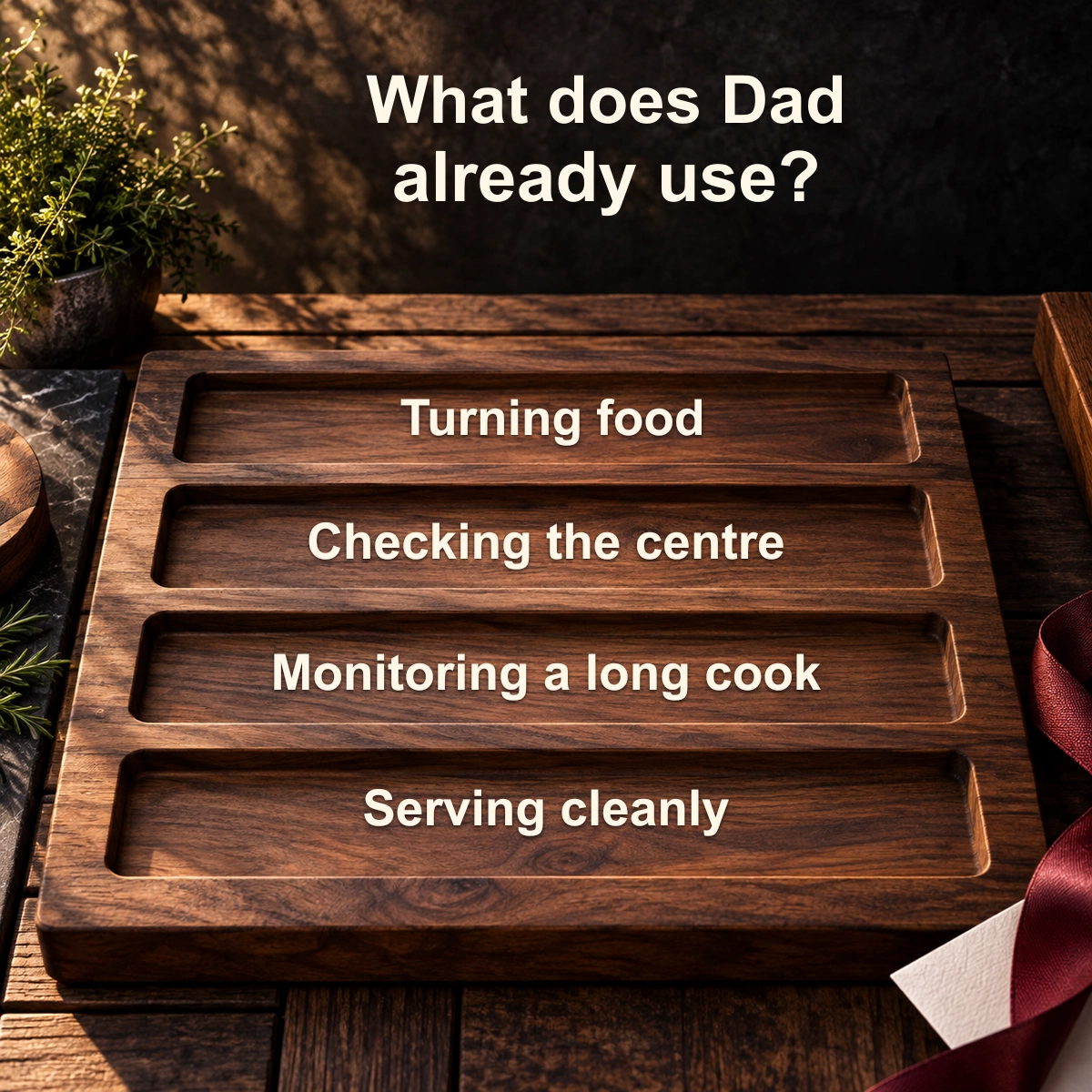
Three gift situations, with different sensible choices
These are examples of household situations, not customer stories or product tests. Choose the one closest to the recipient, then check the details that could make the gift unsuitable.
| Dad's usual cooking | A possible gift direction | What to establish first |
|---|---|---|
| Burgers or chicken for a weeknight meal | A spot-check food thermometer, or tongs with an integrated probe | Whether he already has a tool he likes and can position it comfortably |
| A large cut cooked over several hours | A monitoring thermometer rated for the intended cooking method | Probe suitability, heat limits, alerts and any phone requirements |
| A well-equipped barbecue with favourite tools | Ingredients, a requested replacement or a shared meal | Food preferences, dietary needs and the exact replacement model |
The weeknight cook who checks individual portions
Picture a family supper with several burgers of different thicknesses. A thermometer helps answer a question about the centre of each portion. Buying another set of utensils may do little if the existing tongs are comfortable and in good condition, while a suitable measuring tool fills a different need.
A standalone digital thermometer lets the cook keep using familiar tongs. A combined tool may appeal to someone who wants the probe available alongside the tool used to handle food. Neither arrangement removes the need to position the probe properly or keep raw-food equipment separate from clean serving equipment.
For this recipient, ask about the grip and display as well as the specifications. Can he read the number in his usual cooking position? Is the tool manageable for the way he holds food? If those details cannot be established online, clear return conditions are particularly useful. A product photograph can't tell you whether a particular person will enjoy the grip.
The cook who likes a long afternoon project
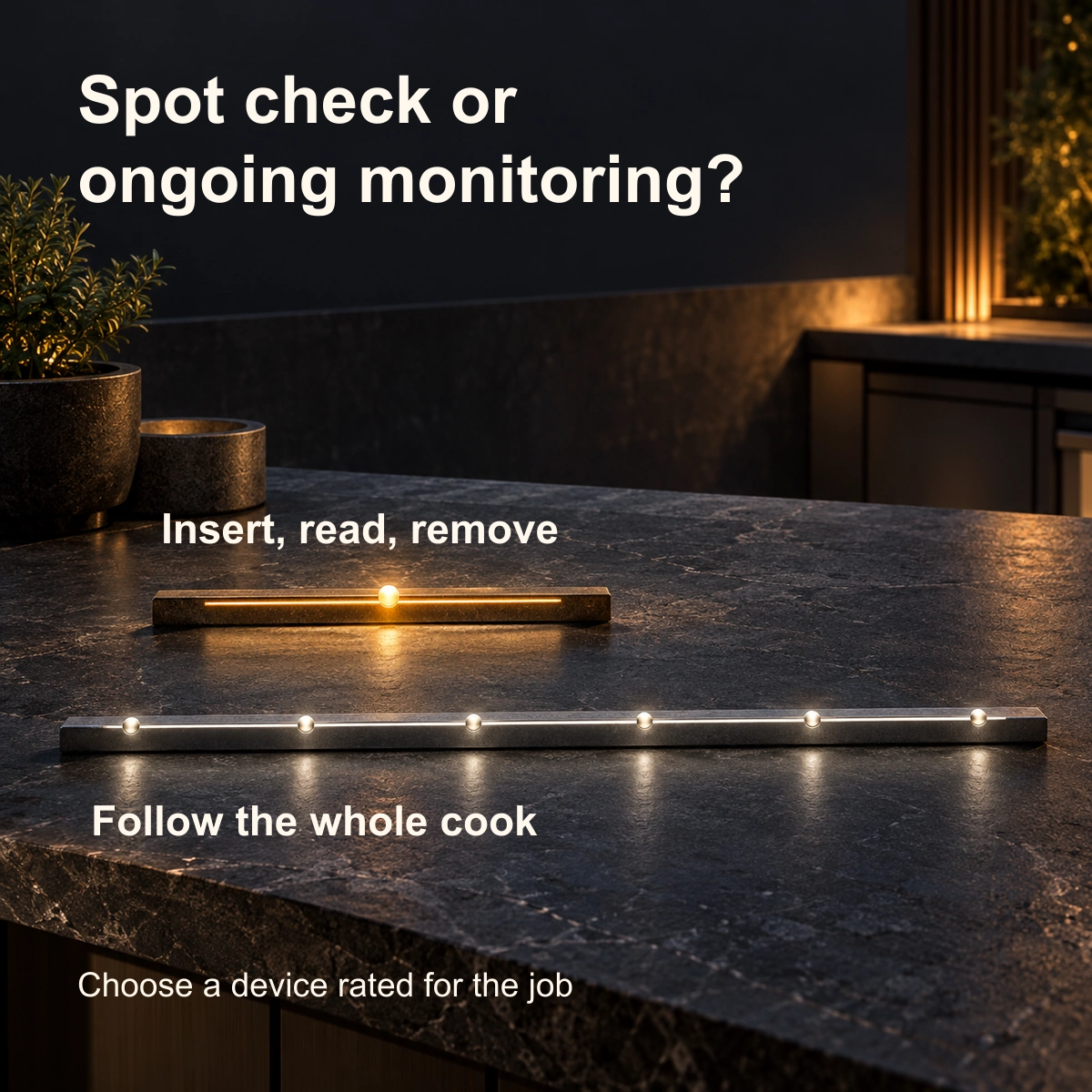
Someone following a long cook may want to see what happens between checks. That is a different job from taking a reading and removing the probe. Look for a monitoring device explicitly intended for the cooking method, with clear instructions about which parts can remain in the food and where other components must sit.
If the device uses a phone, check the recipient's willingness to use one while cooking. An app can be welcome to one person and an unwanted extra task to another. Confirm compatibility and the actual alert arrangement for the exact model; a wireless label alone doesn't explain either.
This is also where a gift conversation can save money. If Dad already has an effective monitoring setup, replacing it without asking risks losing features he values. He may prefer a spare part specified by its exact model, or ingredients for the next cook. An integrated spot-check tool should not be presented as a substitute for continuous monitoring.
The cook whose equipment is already sorted
A well-equipped griller can still appreciate a gift, but there is no need to manufacture an equipment problem. Ask about a sauce, seasoning or recipe he wants to try. Check ingredients, allergies and heat preferences rather than choosing a large assortment purely for its appearance.
For example, someone who enjoys a mild sauce may get more use from one familiar flavour than an ambitious collection of hot sauces. If you buy ingredients for a shared meal, agree on the menu and storage arrangements. Perishable food needs more planning than a wrapped utensil.
A specific offer of help can also be part of the gift: shop for the agreed meal, prepare the vegetables, or take care of washing up. Keep the plan realistic and let Dad decide how much cooking he wants to do. A gift meal needn't turn into an assignment for its recipient.
When ThermoTongs is worth considering
For a cook interested in having a probe integrated into the handling tool, KINGEAR ThermoTongs is a conditional option. It combines cooking tongs and a digital food-temperature probe in a 12-inch tool with red silicone tips. Its intended temperature-checking workflow is to insert the probe, read the temperature and remove it.
The reason to consider that arrangement is convenience of access to the probe during food handling. Whether that convenience matters depends on the cook. Someone attached to their existing tongs and separate thermometer may prefer to keep both. A person seeking alerts throughout a long cook needs a different type of device.
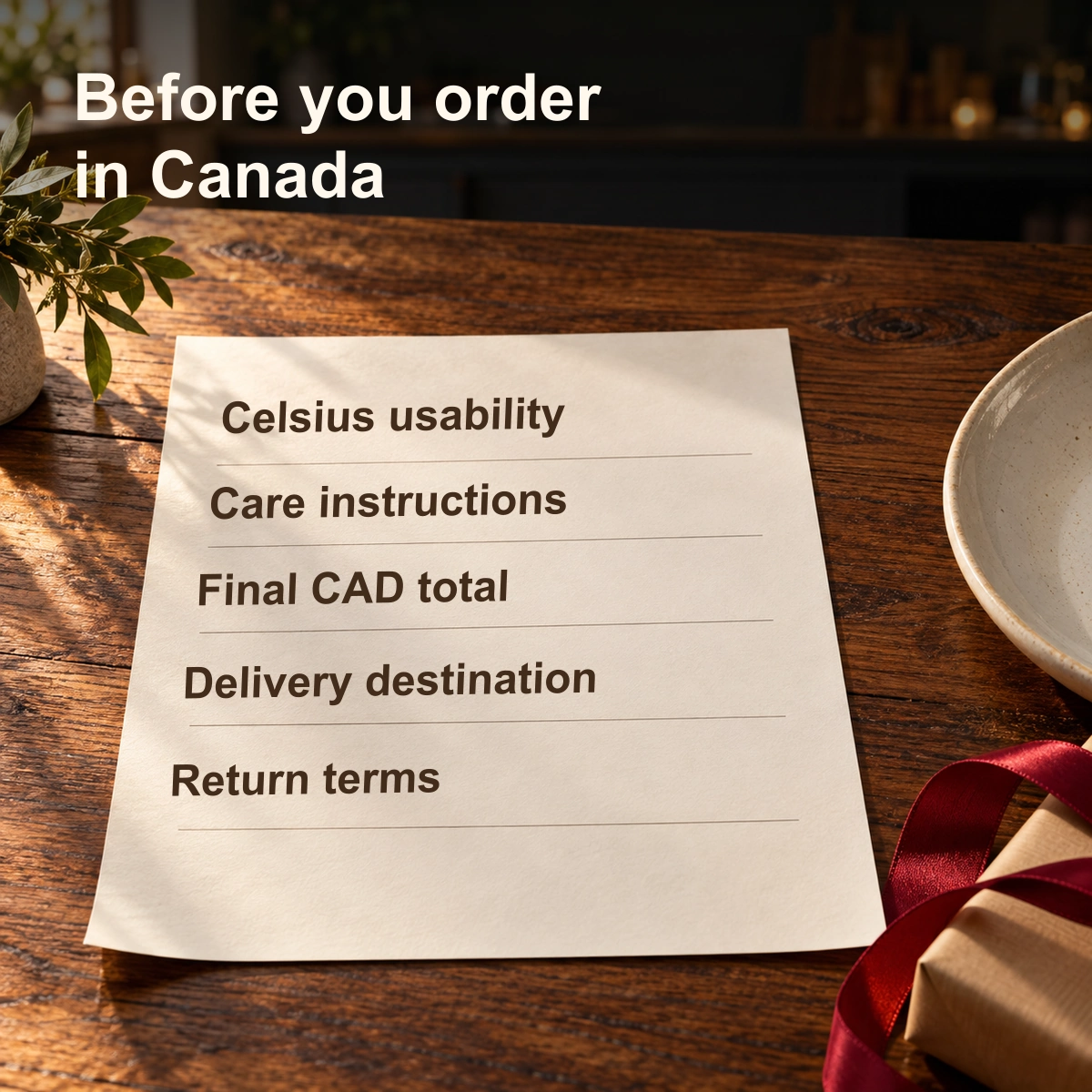
Cleaning requirements belong in the buying decision, too. Don't assume that electronic tongs can be immersed or put in a dishwasher. Follow the supplied care instructions for food-contact surfaces and electronic areas. If Dad expects every utensil to go straight into the dishwasher, establish whether the required care routine suits him before making it a gift.
You can share the Canadian ThermoTongs use guide if he wants to understand the operating steps before deciding. He can then judge whether having the probe in the same tool suits his cooking. A combined tool still depends on careful positioning and handling.
Give the thermometer a useful Canadian starting point
If a thermometer is part of the gift, help the recipient connect the reading with the food being cooked. Celsius usability is worth checking even when the household also follows recipes written in Fahrenheit. Confirm the exact model's display and unit controls rather than assuming every digital tool offers the same options.
Health Canada's safe cooking temperatures give food-specific targets. For example, ground beef burgers should reach 71°C (160°F), while chicken pieces should reach 74°C (165°F). These examples aren't interchangeable, and a preference for steak doneness doesn't replace the guidance for ground meat or poultry.
A small note with a link to the official chart can make the gift easier to start using. Keep it specific: identify the food Dad usually cooks, point to the relevant category and encourage him to check the current instructions. A generic card saying "cook everything to this number" would be misleading.
The measuring position matters as well. Health Canada advises checking the middle of the thickest part, avoiding bone, and inserting through the side for burgers. Check each piece separately. This article is about choosing a gift, so use the official chart for the full range of foods rather than treating these two examples as a complete cooking guide.
Think through cleaning and serving before adding extras
A thermometer gift can prompt a useful look at the whole preparation area. Is there a clean plate available for checking and serving? Can raw-food utensils stay separate? Those questions may reveal that a platter or another appropriate utensil is the more useful addition.
Health Canada's barbecue guidance recommends taking food off the barbecue onto a clean plate to check its temperature. It also calls for separate equipment for raw and cooked food and cleaning the thermometer between readings. Colour alone doesn't establish that meat is safely cooked.
For a combined tong-and-probe tool, both the tong surfaces and the probe deserve attention after contact with raw or undercooked food. Combining functions doesn't make cleaning unnecessary. Use the product's care instructions alongside safe food-handling guidance; avoid soaking electronic parts simply because food-contact surfaces need cleaning.
As an illustrative gift setup, you might put the chosen tool beside a clean serving platter and include the instructions in the box. That makes its intended use clear without staging a pretend test. If you add a cleaning accessory, verify that it suits the product's materials and care directions. There is little value in a gift bundle whose cleaning method conflicts with the tool.
Check the Canadian order, not just the gift photograph
Before paying, confirm that you are shopping in the intended market and that the final total uses the currency you expect. A Canadian-looking page or a dollar sign alone isn't enough to establish the delivered cost. Review the actual order for the chosen address, including any displayed delivery charges and applicable taxes.
For a gift needed on a particular date, check the retailer's current delivery information and the estimate offered for that destination. Don't turn a general delivery range into a promise. If the available information doesn't give you enough confidence, choose a gift that you can obtain within your plans or explain the timing honestly to the recipient.
Returns deserve attention when buying ahead. Establish when the return window starts, whether opening or using the item affects eligibility, what proof of purchase is needed and who handles the request. Keep the receipt accessible. A purchase through a marketplace may follow different procedures from a direct order, even when the product has the same brand name.
For ThermoTongs, consult KINGEAR's Canadian product and order support for the published conditions. The listed package includes the tool, documentation and retail presentation box. Retail packaging is different from extra gift wrapping, so check any wrapping service separately. Avoid promising an accessory or bundle that the exact listing doesn't include.
Questions to settle before choosing
What can I give a grilling dad who already owns a thermometer?
Find out whether his thermometer already does the job he wants. If it does, consider favourite ingredients, an explicitly requested replacement part or a meal together. Another thermometer makes sense only when it fills a different need or replaces something he wants to retire.
Is a combined tong-and-thermometer tool suitable for a beginner?
It can be an option for a beginner who wants that arrangement and is willing to follow the positioning and care instructions. A combined tool still requires safe handling, appropriate food-temperature guidance and cleaning. Familiar separate tools may be a better fit for someone who prefers them.
Can ThermoTongs stay in the food throughout cooking?
No. ThermoTongs is intended for spot checks: insert the probe, take the reading and remove it. For ongoing monitoring, choose equipment specifically rated for that purpose and follow its instructions for the intended cooking method.
Should a Canadian gift buyer choose Celsius or Fahrenheit?
Check what the recipient uses and confirm the exact model's unit options. Celsius is useful for following Health Canada's guidance; some recipes use Fahrenheit. Don't assume that a particular device can switch units without checking its documentation.
Does gift-ready packaging mean gift wrapping is included?
No. A retail presentation box describes the product's packaging. Extra wrapping, a gift message or other additions must be explicitly offered for the order. Check the listing and checkout before including those details in your gift plan.
How can I keep the surprise without buying the wrong accessory?
Ask about a recent meal or an intended recipe, or ask someone who cooks with Dad to confirm his equipment with permission. For model-specific accessories, get the exact model. If that isn't possible, choose a gift that doesn't depend on an unverified fit.
Make the choice around one actual meal
Before ordering, name the meal the gift will help with and the job it will do. A weeknight burger cook may benefit from a suitable spot-check tool. A long-cook enthusiast may want monitoring equipment. Someone happy with their setup may prefer dinner ingredients and company.
Once you can explain the fit in a sentence, check the instructions and the order conditions for your Canadian address. Keep the receipt, include the documentation and leave Dad free to tell you if another arrangement would suit him better.
Sources
- Health Canada: Safe cooking temperatures.
- Health Canada: Food safety tips for barbecuing.


